Antifragile
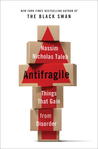 Antifragile: Things That Gain from Disorder by Nassim Nicholas Taleb
My rating: 4 of 5 stars
Angry, acerbic and ultimately correct about his most central tenets, Taleb offers an alternate take on everything ranging from finance, biology, healthcare, morality and innovation. In this season of politics, the reader is often reminded of parallels between him and Donald Trump as close to 90% of the book is written with an adversarial tone though unlike the future president, Taleb is ultimately correct on almost every front(no wall building etc.). Like most of his books, Taleb’s alter-egos, Fat Tony and Nero Tulip star in cameos, taking the entertainment quotient through the roof. As always, name calling is the order of the day, as anyone with divergent views gets labelled a ‘fragilista‘(Stiglitz, Krugman, empty suits, federal reserve etc.) or worse.
His criticisms are crafted under the framework of how systems react to stochastic perturbations. To illustrate the point, consider the response of a porcelain cup to movement. In the space of possible mechanical perturbations, most outcome states are unfavourable to the structural sanctity of the cup. In contrast, a rubber ball is likely to maintain its structure under most conceivable perturbations. Taking the analogy further, systems that reap benefits from random fluctuations are categorized as ‘anti-fragile‘(the author takes great delight in pointing out that he coined the term while acknowledging that the idea pre-dates him by centuries.). The airline industry, human physiology, Fat Tony’s trading strategies etc. are cited as examples of anti fragility in action. Along the way, Taleb advises a barbelled strategy that aims at gaining from disorder while staying safe in the long run. For instance, a scientist should invest most of his funding in low-risk, tried and tested research areas while reserving some amount for high risk, high payoff research, thereby putting himself in a position that shields him from volatility while providing exposure to some of its beneficial aspects. For Taleb, top-down, theory driven intervention often has the effect of fragilizing systems. He cites(or rather rails against) medical iatrogenics as an example of how naive theorising often fails miserably when confronted with extremely complex systems such as the human body. The take home message is simple - focus less on calculating probability distributions and more on the consequences of those distributions.
For me, the most enlightening of all are his views on exercise, particularly weight-training.
In line with his ideas on ‘convex-transformation’, Taleb advocates moderate intensity workouts on most days, punctuated by episodic bursts of high intensity, one-rep maximum power-lifting(he claims to deadlift 300+ pounds once a week), effectively mimicking the paleo-ancestor regimen. His deference to everything old can be questioned, but this is tempered by the fact that Taleb expends a lot of pages(and insults) explaining how crisp rules of thumb often trump formal theories when it comes to decision making under uncertainty in complex systems such as medicine,biology and finance. Taleb rails incessantly against neo-mania, with its insistence on via-positiva instead of the more organic via-negativa.
Replete with witty aphorisms, neologisms and barbs, Taleb is at his confrontational and pedagogical best in this book.